
Key takeaways
- The standards have been available for voluntary use since February 2026.
- The Financial Conduct Authority’s (FCA) final rules put every UK Sustainability Reporting Standards (UK SRS) requirement on a comply or explain basis, including Scope 3. Scope 3 has 1 year of relief and the wider S1 topics have 2.
- Disclosures come out with your annual financial statements, and you must say whether they’re assured and whether you’ve published a transition plan.
- S1, the general standard, covers any sustainability risk or opportunity that could affect your cash flow, finance or cost of capital.
- S2, the climate standard, covers climate risk, scenario analysis, financial effects and emissions.
- Companies already reporting under the Task Force on Climate-related Financial Disclosures (TCFD) start well ahead on governance and risk management, but are almost level with non-reporters on climate metrics.
When the FCA confirmed its UK SRS rules in September, many headlines read them as a reprieve: comply or explain, with no mandatory climate disclosure. In practice, comply or explain is a decision taken requirement by requirement, with every explanation published in your annual report. Based on 16 gap analyses we’ve run this year, most companies would be explaining most of the climate standard if they reported today.
Why comply or explain is a decision you make now
For every requirement, you choose whether to disclose or explain why you haven’t, and you can only choose once you know where your gaps are.
An explanation has a cost. Under the FCA’s draft guidance, it lists the requirements you’ve missed, why, and what you’ll do about them, in your annual report where investors can compare you with peers. Explain on any part of S2 and you can’t make a clean statement of compliance.
“You can’t explain away something you haven’t looked at” says Alex Kyloh, Carbon and Reporting Consultant at Seismic, who worked on the first year of mandatory reporting in Australia. For calendar-year companies, your first report covers data from 1 January 2027. A gap left open then is one you explain in 2028.
How ready are companies for UK SRS?
Since spring, we’ve run UK SRS gap analyses for 16 companies. A gap analysis shows a business exactly where it stands against the standards and what it needs to close. In each one, we scored the company against every requirement in S2, the climate standard, as fully met, partly met or not met. S2 is organised into 4 areas: governance, strategy, risk management, and metrics and targets.
None of the 16 companies are close yet:
- On average, companies fully meet a quarter of what S2 asks for. Half isn’t met at all.
- Even the best-prepared company fully meets only about half.
- Emissions reporting is the strongest area. Most companies already meet the requirements for their Scope 1 and 2 emissions.
- Strategy is the weakest area and the biggest, holding nearly half of all requirements. Over half of them aren’t met.
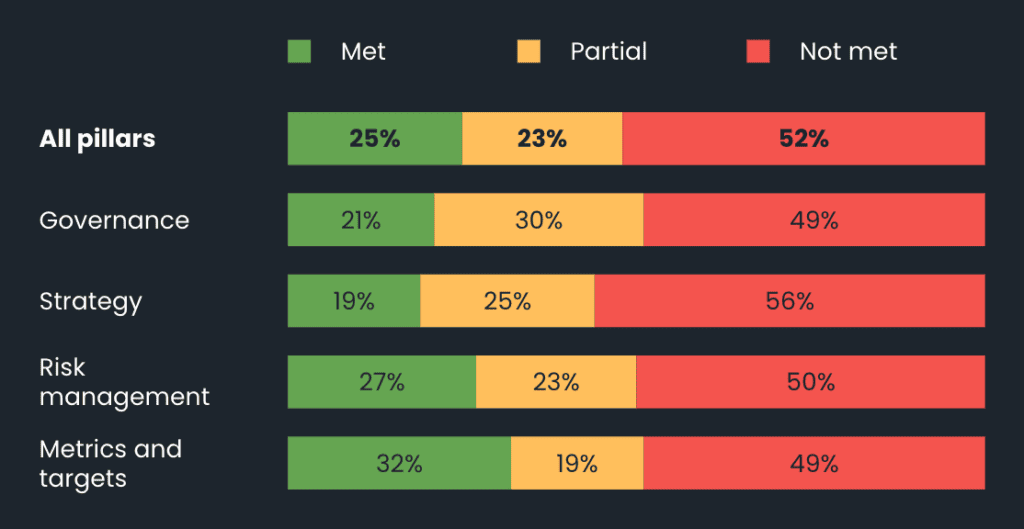
If you already report under TCFD, you’re well ahead on governance and risk management. TCFD reporters missed under a third of governance requirements, against over two-thirds for companies without it. On metrics, though, the gap almost disappears. That’s where S2 asks how climate affects your finances.
Seismic Reporting & Disclosure experts, Alex Kyloh and Josh Eyre, presented these findings at a recent webinar alongside two clients preparing now. Sophie Stephens is Group Sustainability Director at OCU Group, a private equity-backed infrastructure business working across the UK and Australia. When OCU combined two Australian acquisitions, the group crossed the threshold for mandatory reporting there, so it is preparing the whole business at once, UK included. Isabelle Haigney is Sustainability Engagement Lead at Motability Operations, which isn’t in scope yet but is preparing anyway.
Climate is now a question for finance and the board
Companies have the basics: a named owner, some climate scenarios and emissions numbers. What’s missing is proof that climate shapes decisions, and the numbers behind it.
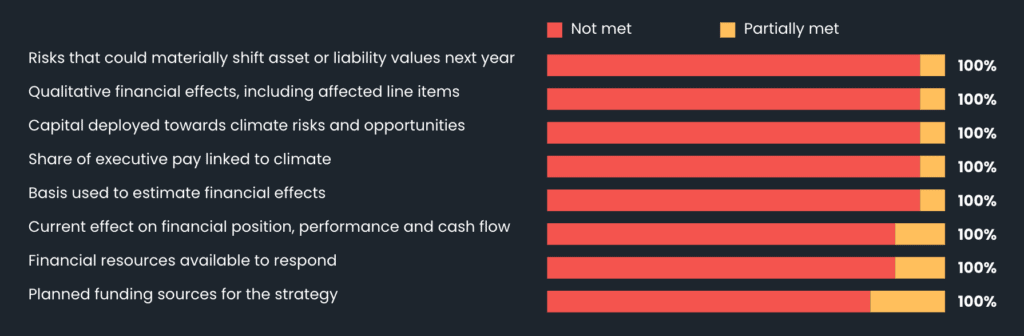
The all important pound sign: On 8 S2 requirements, not one company in our sample was fully compliant. They include which line items climate affects, the capital behind climate risks and how you’ll fund your strategy. Financial effects are the requirements that ask you to put a figure on how climate affects your business. Across all 16 companies, just 4 of 192 scores on these were fully met: about 2%.
Part of the reason is caution at board level. “We looked at potentially putting more financial reporting into our TCFD last year, but because of the sensitivity of that information… the board don’t necessarily want that kind of information out there,” says Sophie. Joshua Eyre, who leads Seismic’s UK SRS work, advises boards: “Ranges are okay, but a blank on this isn’t.”
For many sustainability teams, this is new ground. “Today, [we] don’t touch the back half of our annual report… so that will be new,” says Isabelle.
The board: None of the companies we analysed had checked whether the board has the skills to oversee climate, or could show climate weighed in a major decision such as an acquisition or a new site.
The risk register: Only 2 of 16 rank climate against their other principal risks with the same scoring. At Motability Operations, Isabelle’s team has been working with risk colleagues to describe risks such as flooding, previously logged under business continuity, in climate terms.
Investors are already asking: OCU Group was sold on 5 October. “On the 6th, we then started to look at what our next sale is going to look like, and what we’re going to need to have in place,” says Sophie. Due diligence on the sale focused heavily on climate risk and opportunity, and the work paid off: “We ended up with a good report, and that really impacted the decisions and made us more saleable as a business.”
Lenders are asking too: “We’re seeing lenders asking a lot more around SRS, around carbon reporting, and starting to link that to loans,” says Sophie. And if your customers report, their Scope 3 is your data. The largest private companies already make climate disclosures under the Companies Act, based on TCFD. The government is now consulting on how UK SRS should fit into those rules, and Josh expects reporting to move towards UK SRS.
When to start, and what to do first
In Australia, where the same standards went live in 2025, companies typically took 12 to 18 months to produce a first report, says Alex: “Writing the disclosure is the easy bit, but getting the board to own it, getting your data in shape, particularly Scope 3, and connecting climate risk to actual numbers with the finance team is what you need most time for.” Get the first 3 of these moving before your first reporting year.
- Put figures on your top risks: Estimate the financial effects of your 2 or 3 most material climate risks, as ranges if needed.
- Write climate into the board’s paperwork: Update terms of reference, run a skills assessment, and record where climate shaped a major decision.
- Publish what your scenarios told you: Set out your main uncertainties, how resilient you are, and the financial headroom you have to respond.
- Rank climate alongside your other principal risks: Put it on the main risk register and score it like everything else.
- Govern your targets and investment: Agree a review process for targets, and disclose your climate capital expenditure and any link to executive pay.
The quickest route through all 5 is getting finance, risk and sustainability teams in the same room. And you don’t have to wait until you’re in scope. As Isabelle puts it: “Go and fail at it while no one’s checking, and then hopefully, by the time that you are in scope, you’ll be ready.”
Common questions about climate scenario analysis
-
Is UK SRS mandatory? For in-scope listed companies, the FCA requires reporting against UK SRS on a comply or explain basis for accounting periods starting on or after 1 January 2027. Other companies aren’t required to report yet, and the government is consulting this autumn on who else should.
-
Does comply or explain mean I can skip climate reporting? You can explain instead of disclosing, but the explanation is public. It must set out which requirements you’ve missed, why, and what you’ll do about them, in your annual report alongside your peers.
-
When does UK SRS start if my financial year doesn’t run January to December? The rules apply to accounting periods starting on or after 1 January 2027, so your first year in scope is the first one that starts on or after that date. If your year runs April to March, that’s April 2027 to March 2028, with disclosures published alongside those annual accounts.
-
Where can I find more resources? Watch our on-demand SRS webinar or sign up to our SRS newsletter to receive expert insight straight to your inbox.